Summary
PICAS (Policy Indexed Contiguous Allocation System) is a layered memory allocation framework designed to bridge the gap between traditional low-level allocators (such as malloc, jemalloc, and tcmalloc) and modern, context-sensitive memory management requirements found in real-time systems, adaptive runtimes, and data-intensive workloads. Conventional allocators predominantly rely on local heuristics—such as size classes, freelists, and arena partitioning—or global statistical tuning that reacts indirectly to workload behavior. While highly optimized for general-purpose use, these approaches lack an explicit representation of execution phase, semantic intent, or future allocation trajectory. As a result, they are often blind to higher-level structure in allocation patterns, leading to suboptimal memory placement, premature fragmentation, or uncontrolled cross-arena spillover. PICAS addresses this limitation by introducing a policy-driven yet phase and context aware allocation model in which allocation decisions are explicitly informed by semantic execution context. Memory is modeled not as a flat pool, but as a sequence of logical layers, each associated with both data progression and memory capacity progression. This allows allocation behavior to adapt dynamically as workloads evolve, rather than reacting only after memory pressure has already manifested.
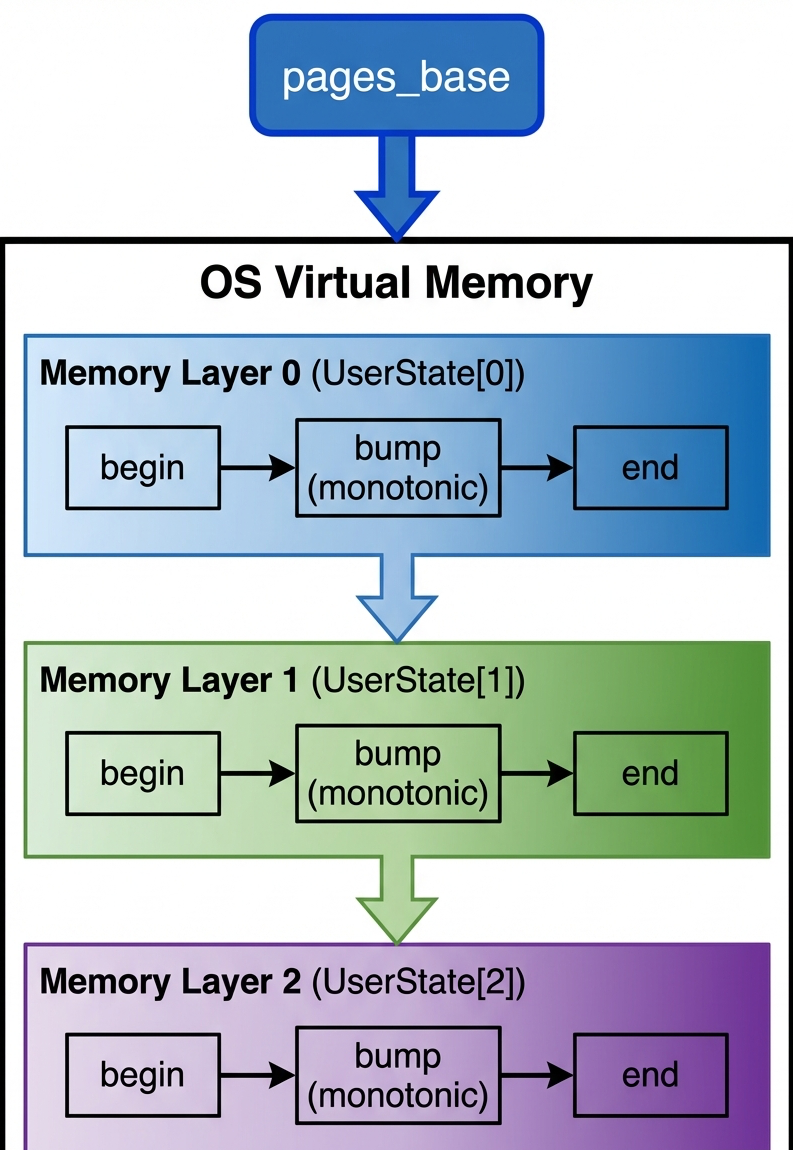
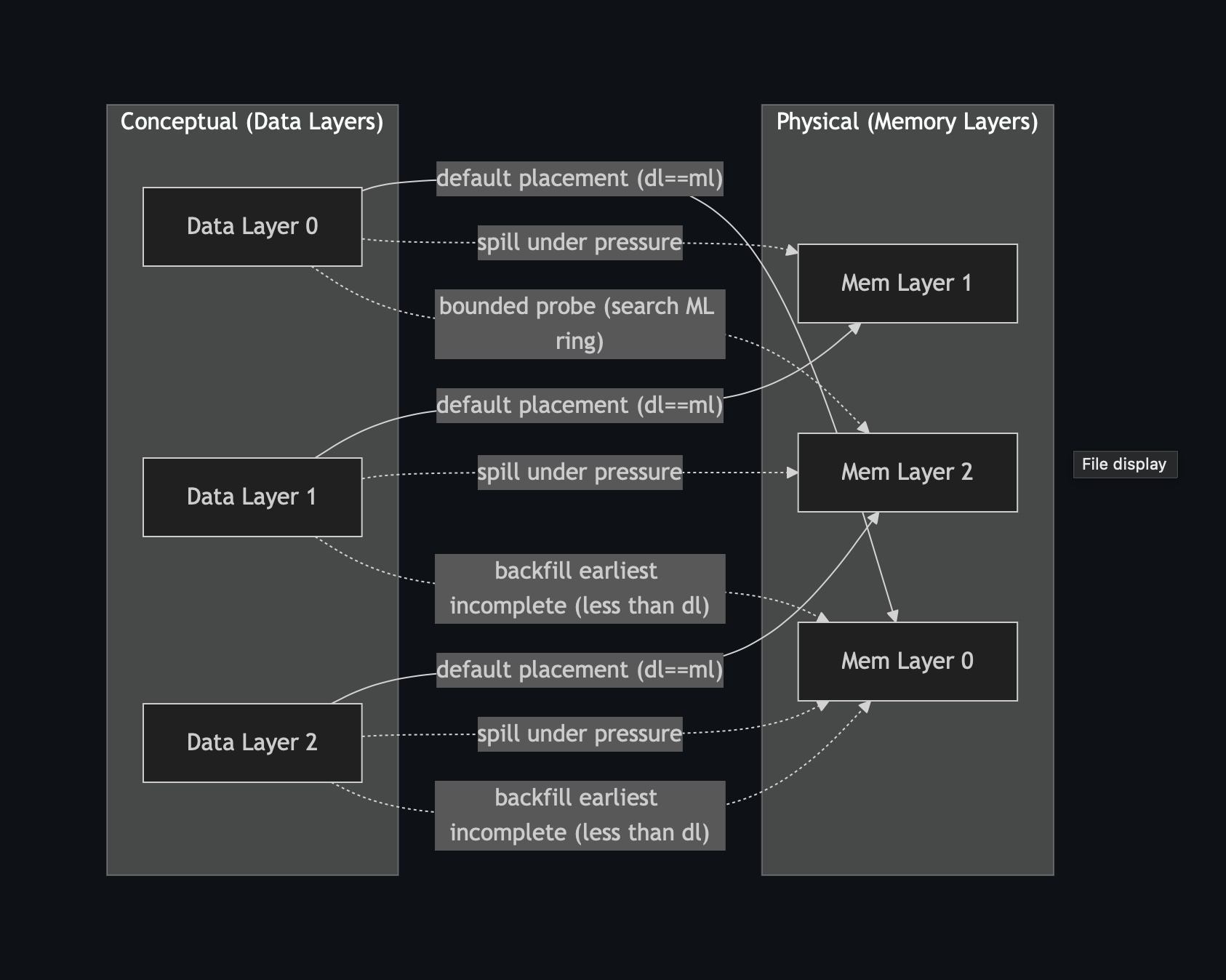
At its core, PICAS implements a dual-layer abstraction:
- Data Layers represent the conceptual phase or progression stage of allocation requests (e.g., initialization, steady-state, streaming, finalization, or algorithmic epochs).
- Memory Layers represent physically partitioned memory regions, each with independent capacity limits, transitory checkpoints, and lifecycle constraints.
Allocation decisions are governed by a policy engine that continuously evaluates real-time signals, including:
- allocation counts and allocated bytes per data layer,
- memory layer transitory points (MEM-TP) and logical full conditions (MEM-LP),
- cross-layer stranding risk and fragmentation potential,
- bounded spill, probe, and backfill opportunities.
This design enables behaviors that are non-expressible in traditional allocators, such as:
- advancing data phases even when memory layers lag behind,
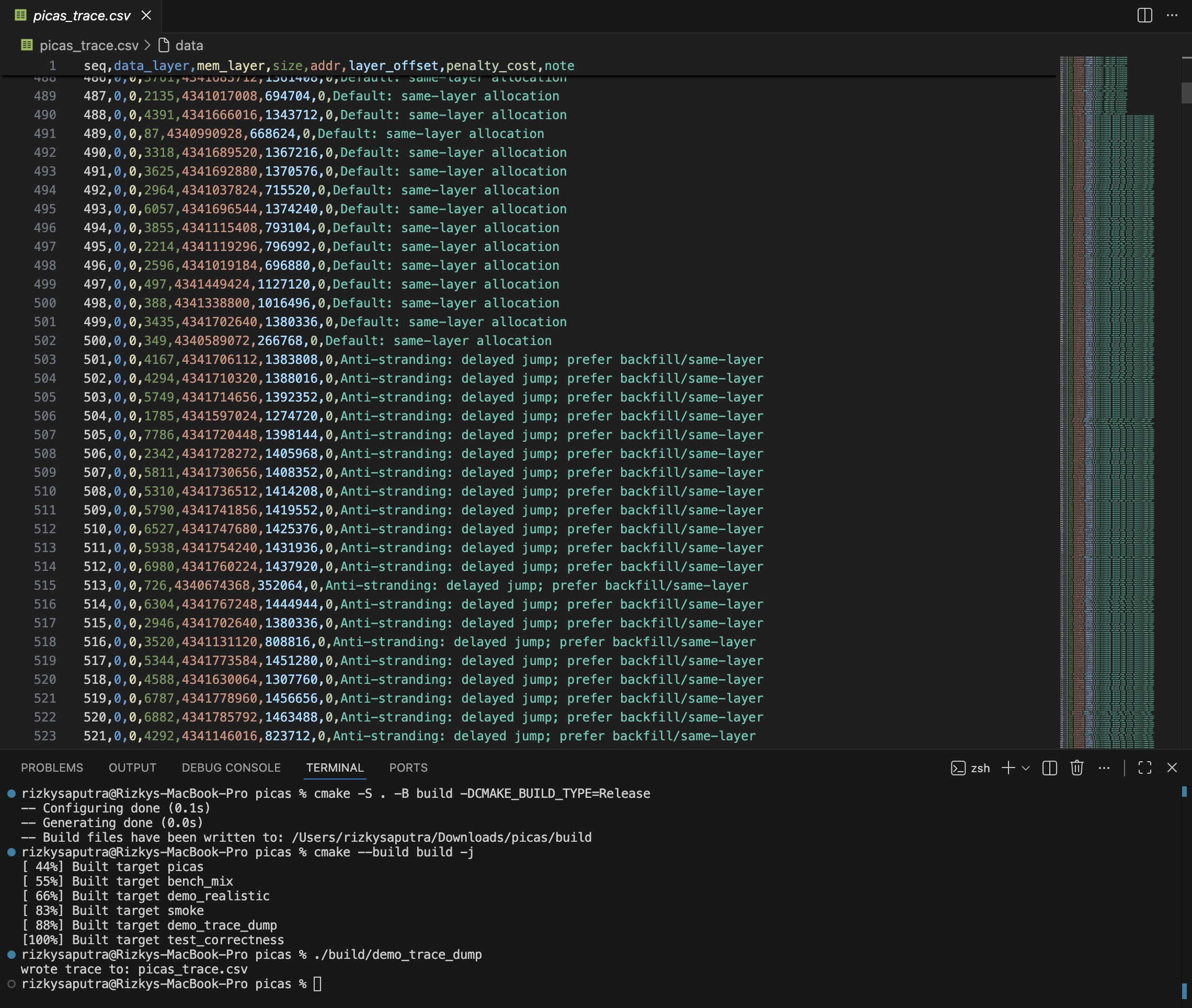
- safely backfilling into earlier memory layers to reduce stranded capacity,
- bounded cross-layer allocation with explicit penalty modeling,
- allocator-level reasoning about future memory pressure, not just current availability.
PICAS follows the same design principles as the SyntraLine++ Compiler: explicit structure, formal reasoning, observability, and extensibility—aiming where in this case is not merely to allocate memory, but simultaneously to model, control, and reason about memory behavior over time.
Research Purpose
PICAS is motivated by the idea that memory allocation should be:
- Context-aware, not purely size-driven
- Policy-driven, not hard-coded
- Phase-aware, not temporally blind
- Observable, not opaque
- Safe, even under pathological workloads
Rather than replacing existing allocators with yet another heuristic, PICAS reframes memory allocation as a controlled progression problem, where both data and memory advance through structured layers under explicit rules.
Future Roadmaps
- System stabilization
- Policy evaluation and extensibility
- Concurrency and scalability
- Integration of advanced memory management algorithms
- Formalization and verification
- Visualization and Run Time Integration
- Domain: Memory System, System Programming, Computer Architecture, Real-Time System
- Core: Policy, Sanitizer, Cache, Virtual Memory
- Neural Networks: Policy, Sanitizer
- Focus: Memory Management, Advanced Algorithms, Smart Allocation System