Summary
Ambientor is a real-time ambient music engine designed as both a creative instrument and a systems-level DSP playground. This project in particular encapsulates the capacity of multi-language stack which combines:
- Rust core DSP (filters, envelopes, waveshaping, scenes)
- C++ host for low-level integration and embedding
- Python bindings for quick scripting and experimentation
- Hand-tuned SIMD assembly (AVX/SSE on x86, NEON on ARM64)
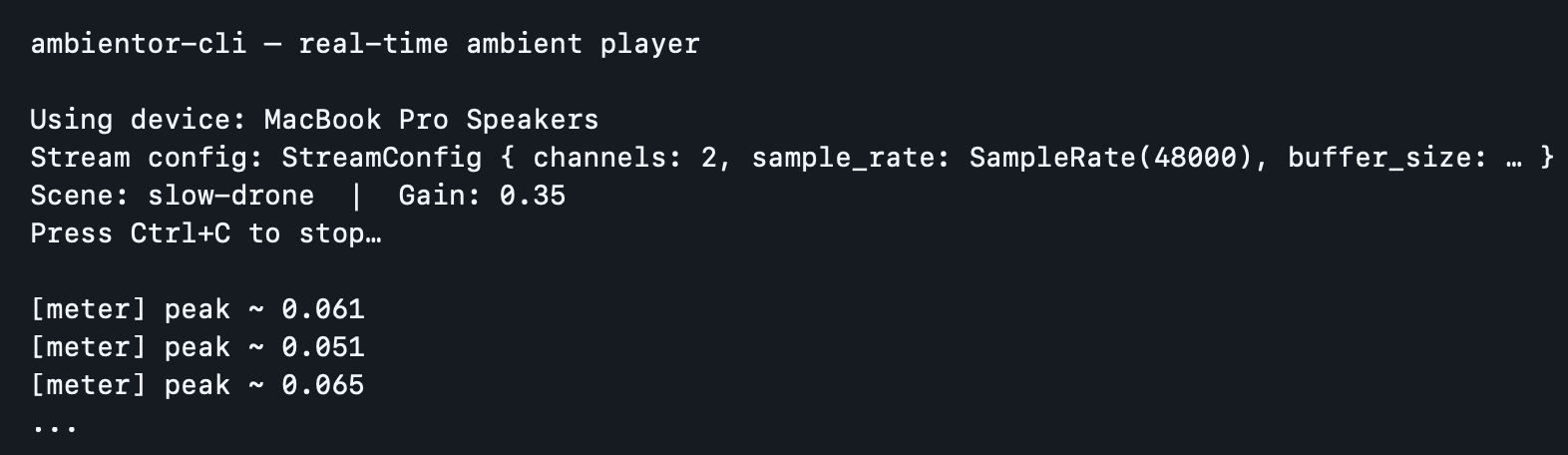
- Realtime CLI player using
cpalon macOS (and portable to Linux)
This multithreaded Ambientor project is designed as a compact, transparent, and academically grounded exploration of how a real-time ambient sound engine can be constructed across multiple programming ecosystems. Instead of expanding into a large or opaque codebase, the system adopts a clean, layered architecture that spans Rust, C++, Python, and low-level assembly, providing a reproducible model for understanding real-time audio generation, systems programming, digital signal processing, and cross-language integration.
At its core, the project emphasizes clarity, modularity, and cross-language interoperability. It demonstrates how:
- Rust’s safety guarantees can coexist with external components via C FFI.
- Rust modules can be embedded within C++ applications without architectural friction.
- High-level languages such as Python can interface with the same engine using
pyo3andmaturin. - SIMD-optimized assembly can be integrated in a controlled, testable, and portable manner.
Functionally, the engine provides real-time stereo audio streaming through the cpal backend while generating evolving ambient textures. These include amplitude envelopes, lightweight filtering, gradual modulation, and slowly dissipating low-frequency layers—behaviors aligned with foundational principles in sound synthesis and modern DSP. This makes the engine not only musically capable but also suitable for experimentation and academic analysis.
Research Purpose
The primary goal of this particular project is to develop a foundation to a sound engine system with its robustness to perform several low-level based functionalities, likewise:
- Run realtime ambient pads / drones / textures.
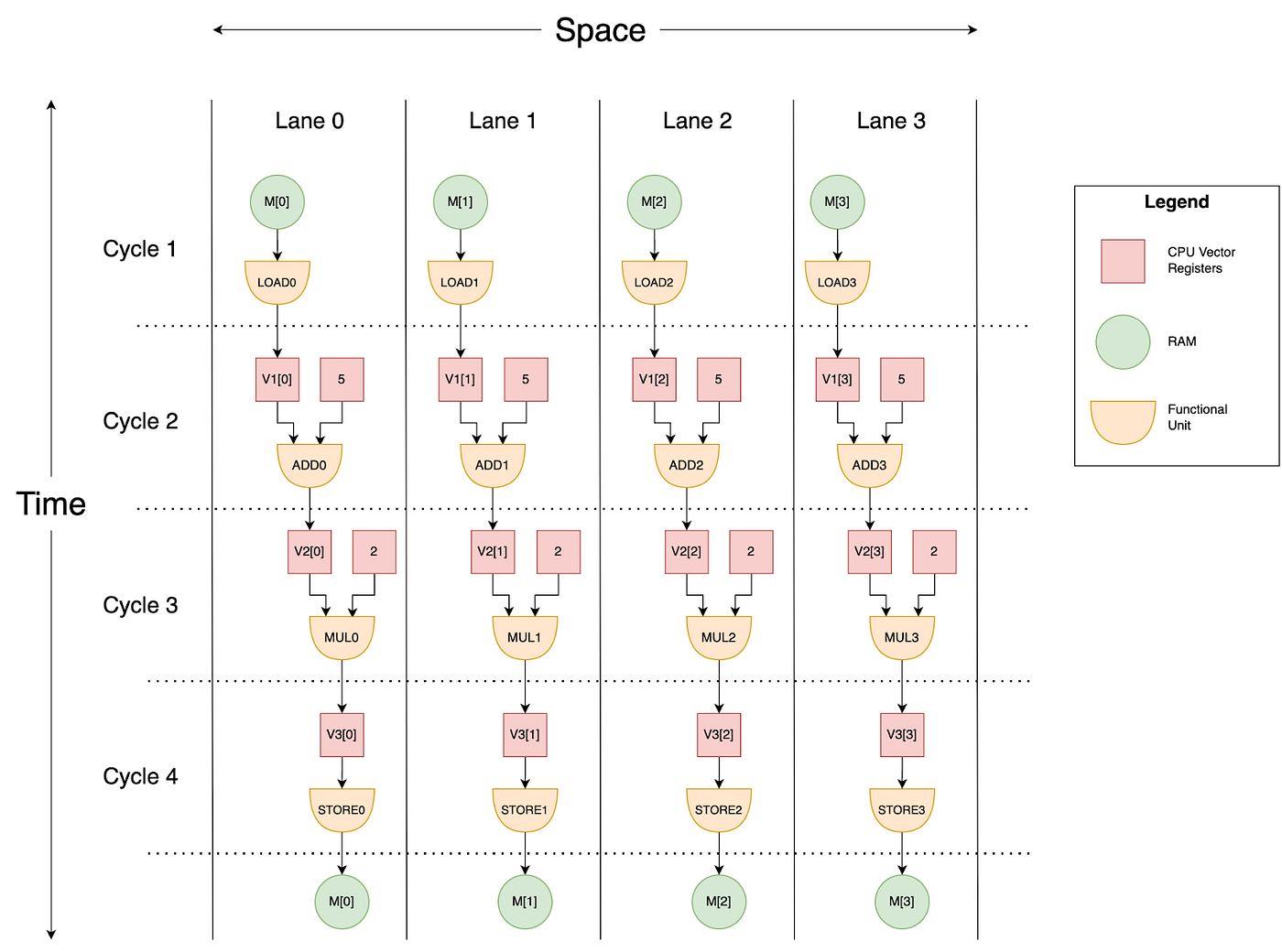
- Demonstrate SIMD acceleration and cross-language FFI.
- Be used as a reference project for:
- Writing DSP based program or code in Rust.
- Calling it with other languages such as C++ and Python.
- Selectively dropping down to assembly for hot paths.
Ambientor is additionally structured around benchmarkability and reproducibility. Its design supports:
- Direct comparison between scalar and SIMD implementations
- Measurement of CPU load, latency, and real-time performance
- Rapid insertion of new waveforms, scenes, or modulation structures
- Systematic evaluation of synthesis components under varying computational conditions
In summary, Ambientor functions as a hybrid of educational reference, real-time audio synthesizer, and performance-oriented research tool, illustrating how a small but well-engineered system can bridge languages, abstractions, and low-level optimizations within a unified ambient audio engine.
Future Roadmaps
- Offline renderer
- More advanced scenes
- Modulation matrix with LFO routing
- Preset system integration
- GUI front-end setup
- Benchmark harness with scalar and SIMD comparison

- Domain: Embedded System, Audio Processing, Hardware/Software Co-Design, Computer Architecture
- Core: DSP, SIMD, CLI, FFI
- Architecure: DSP, SIMD
- Focus: Audio Classification, Multithreading, Parallelism